Steel Pole: Modern Steel Pole Solutions for Reliable and Sustainable Infrastructure
In the midst of the development of modern infrastructure, the need for reliable lighting systems and utility networks continues to increase. Highways, industrial areas, commercial areas, ports, airports and various public facilities require supporting facilities that are able to operate safely and sustainably in the long term. One component that has an important role in the system is Steel Pole or steel poles.
Although often considered a complementary element, steel poles are actually an important part that supports various utility and lighting devices. The quality, strength and reliability of steel poles will greatly influence the stability of the system they support. Therefore, choosing the right steel pole is an important factor in the success of modern infrastructure development.
The Role of Steel Poles in Modern Infrastructure
Steel poles function as support structures for various utility and lighting needs. This product is widely used as street light poles, industrial area lighting poles, CCTV poles, telecommunications network poles, and various other public facility support systems.
As the needs for urban infrastructure and industrial areas increase, the use of steel poles is increasingly popular because it offers a combination of structural strength, modern appearance, and efficiency in installation and maintenance.
Compared to conventional materials such as concrete or wood, steel poles have a number of advantages that make them the main choice in various building projects. The slim design allows more efficient use of space without reducing the structure's ability to withstand operational loads.
The Strength of the Structure is the Main Advantage
One of the main reasons for using steel poles is their high mechanical strength. Steel has an excellent strength to weight ratio, so it can support various equipment safely without requiring too large dimensions.
In its use, steel poles must be able to withstand various loads, both permanent loads and environmental loads. These loads include the weight of lamp armatures, cables, supporting devices, wind pressure, vibration, and other environmental factors that occur during the operational period.
Through the right engineering design process, steel poles can be designed to meet the specific needs of each project. Structural calculations are carried out by considering the height of the pole, installation location, environmental conditions, and the type of equipment that will be installed on the pole.
The result is a structure that is not only strong, but also stable and safe under a wide range of operational conditions.
Galvanized Protection for Long Term Durability
One of the biggest challenges with steel structures placed in open areas is the risk of corrosion. Exposure to rain, humidity, air pollution and aggressive environments can accelerate the deterioration of material quality if adequate protection is not provided.
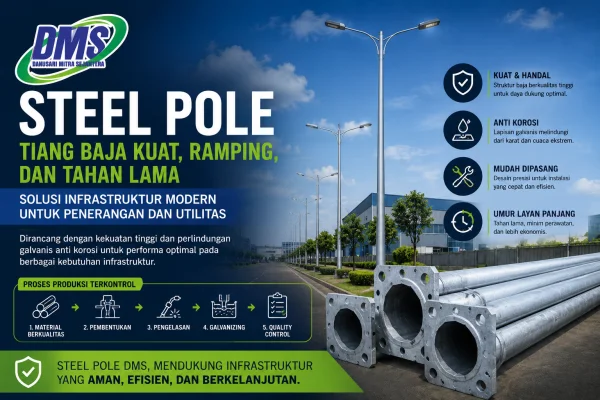
To overcome this, steel poles are generally equipped with a galvanized layer through a hot-dip galvanizing process. In this process, the steel surface is coated with liquid zinc which forms a protective layer against corrosion.
The galvanized coating not only protects the outer surface, but also provides electrochemical protection that helps extend the service life of the product. With proper protection, steel poles can last for decades with relatively low maintenance requirements.
These advantages make steel poles a more economical investment in the long term, especially for infrastructure projects that require high reliability and efficient maintenance costs.
Controlled Fabrication Process
The quality of a steel pole is not only determined by the material used, but also by the fabrication process applied during production. Each stage of production must be carried out in a controlled manner to ensure the final result complies with the established engineering specifications.
The fabrication process starts from selecting steel materials that meet quality standards. After that, the process of cutting, forming and connecting components is carried out according to the design that has been designed.
The welding stage is an important part of the production process. Welded joints must be of good quality to ensure the overall strength of the structure. Therefore, each connection generally goes through a quality inspection according to applicable procedures.
After the entire fabrication process is complete, the steel pole undergoes the finishing and galvanizing stages before final inspection. This inspection aims to ensure that the dimensions, surface quality and completeness of the product meet the required specifications.
With a strict quality control system, every unit produced has a high level of consistency and quality.
Ease of Installation and Operational Efficiency
Apart from having good strength, steel poles also offer ease in the installation process. The relatively lighter weight compared to several alternative materials allows the lifting and installation process to be carried out more efficiently.
Precise design also helps speed up work in the field because each component has been prepared according to project needs. This contributes to reducing construction time and increasing productivity during work execution.
From an operational perspective, steel poles require simpler maintenance thanks to their galvanic protection. This condition helps project owners reduce maintenance costs during the period of use.
Supporting Secure and Sustainable Infrastructure
Modern infrastructure development demands not only strength and efficiency, but also sustainability. Products that have a long service life, low maintenance requirements, and are able to operate reliably are an important part of supporting sustainable development.
Steel poles meet these needs through a combination of quality materials, precise engineering design and controlled production processes. This product is able to support various lighting and utility needs with a high level of reliability in the long term.
As part of its commitment to supporting national development, PT Danusari Mitra Sejahtera (DMS) presents Steel Pole solutions designed to meet modern infrastructure needs in various sectors, from roads, industrial areas, commercial areas, to public facilities.
Conclusion
Steel Pole is an important component that supports the success of various modern utility and lighting systems. With high structural strength, galvanized protection against corrosion, and a controlled fabrication process, this product is able to provide reliable performance and a long service life.
By implementing strict quality standards at every stage of production, from material selection to final inspection, DMS ensures that every steel pole produced is ready to support infrastructure needs safely, efficiently and sustainably.
Behind the lighting system that functions every night and the utility network that supports daily activities, there are steel poles that are precisely designed and built to provide long-term reliability for the future of Indonesia's infrastructure.
PT. Danusari Mitra Sejahtera remains committed to delivering the best service to our clients. With over 19 years of experience in steel construction and fabrication, we support national infrastructure projects.
"Quality is our top priority in every project we deliver."
For more information about our products and services, please contact our team.