
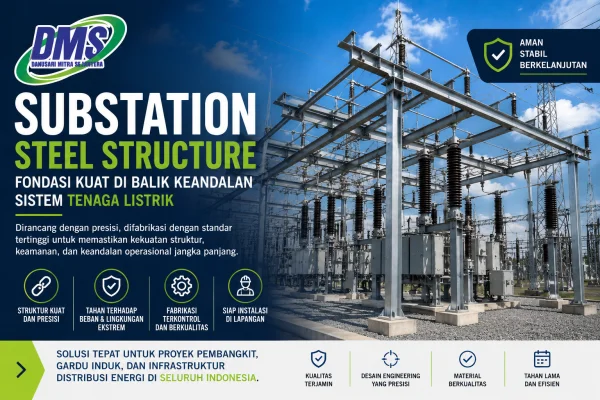
Substation Steel Structure: The Strong Foundation Behind Electric Power System Reliability
In modern life, electricity has become an inseparable need for various community activities, industry, business and public services. The reliability of electricity supply determines the smooth running of various sectors that support economic growth and national development. However, when discussing electric power systems, attention is often focused only on transformers, conductors, switchgear, or other electrical equipment. In fact, there are important components that act as the physical foundation of the entire system, namely Substation Steel Structure.
The steel structure of the substation is an element that supports various electrical equipment so that it can operate safely, stably and sustainably. Without a strong and reliable structure, even the most technologically advanced equipment will not be able to work optimally. Therefore, the quality of steel structures is an important part of maintaining the reliability of electrical energy distribution and transmission systems.
Vital Role of Substation Steel Structure
Substation Steel Structure is a steel frame designed to support various main equipment in substations and transmission networks. This structure functions as a support for equipment such as disconnect switches, current transformers, voltage transformers, busbar supports, lightning arresters, and various other supporting components.
The role of steel structures is not just to support the weight of equipment. The structure must also ensure that each device is in the correct position according to the engineering design. The accuracy of this position is very important to maintain a safe distance between equipment, avoid operational disruptions, and ensure the safety of personnel carrying out maintenance.
In an electric power system, operational stability is greatly influenced by the reliability of all supporting components. Therefore, substation steel structures are an integral part of a modern and sustainable energy system.
Environmental Challenges and Operational Expenses
Substation Steel Structures are designed to operate in a variety of environmental conditions, which are often quite extreme. In contrast to structures located inside closed buildings, substations generally operate in open areas and are continuously exposed to weather conditions.
The structure must be able to withstand wind pressure, rain, temperature changes, high humidity, and long-term exposure to ultraviolet light. In certain areas, structures must also be designed to withstand earthquake loads according to the level of seismic risk in that area.
Apart from environmental factors, steel structures must also be able to withstand operational loads originating from the electrical equipment installed. All these loads must be calculated accurately so that the structure remains stable and safe throughout its operational period.
The ability to face a combination of environmental and operational loads is what makes the design of substation steel structures require a very mature engineering approach.
Quality Materials for Long Term Reliability
Material quality is the main factor that determines the performance of a steel structure. The material used must have mechanical strength in accordance with design requirements and meet applicable quality standards.
The selection of high quality steel provides the structure with the ability to withstand long-term loads without experiencing a significant decrease in performance. In addition, the right material also helps increase resistance to corrosion and other environmental factors.
To increase service life, substation steel structures are generally equipped with surface protection systems such as galvanization or special coating. This protection helps keep the steel in optimal condition even after years of use in challenging environments.
With a combination of quality materials and adequate protection, steel structures can provide a high level of reliability while reducing maintenance requirements.
Precision Engineering Design
The success of a Steel Structure Substation is not only determined by the material, but also by the quality of the engineering design used. Each structure must be designed based on a comprehensive load analysis and taking into account all possible operational conditions.
The engineering team calculated various parameters such as dead load, live load, wind load, earthquake factors, as well as space requirements for electrical equipment installation. The calculation results are then translated into a safe, efficient and economical structural design.
Precise design also provides benefits during the construction phase. Components produced according to engineering drawings will be easier to install in the field, reduce the risk of installation errors, and speed up project completion.
Controlled and Quality Fabrication
After the design is complete, the next stage is the fabrication process. At this stage, engineering drawings are transformed into physical components that are ready for use in the field.
The fabrication process includes cutting material, drilling, forming, welding, and surface coating. All stages are carried out with a strict quality control system to ensure each component meets the specified specifications.
Quality checks are carried out regularly, starting from material verification, dimensional inspection, to checking welded joints. The goal is to ensure each component has consistent quality and is ready to use without requiring additional modifications during installation.
With a controlled fabrication process, the risk of production errors can be minimized so that projects can run more efficiently and on time.
Supporting Sustainable Energy Infrastructure
The increasing need for energy in various regions demands the development of electricity infrastructure that is increasingly reliable and sustainable. Substations and transmission networks are an important part of ensuring energy can be distributed effectively from the generating source to the end user.
Substation Steel Structure acts as a physical foundation that allows the entire system to operate properly. Strong, precise and durable structures help maintain continuity of electrical service while supporting long-term operational efficiency.
Investments in quality steel structures not only provide technical benefits, but also support the sustainability of the national energy infrastructure through reduced maintenance costs and increased asset service life.
Conclusion
The reliability of an electric power system depends not only on the sophistication of the electrical equipment, but also on the supporting structures that support it. Substation Steel Structures have an important role in ensuring that all substation equipment and transmission networks can operate safely, stably and sustainably.
Through the use of quality materials, precise engineering design, and controlled fabrication processes, substation steel structures are able to face various operational and environmental challenges with a high level of reliability. Behind reliable energy distribution, there is a structure designed and built with great care to support the needs of society and industry.
Strong structure for sustainable energy.
PT. Danusari Mitra Sejahtera remains committed to delivering the best service to our clients. With over 19 years of experience in steel construction and fabrication, we support national infrastructure projects.
"Quality is our top priority in every project we deliver."
For more information about our products and services, please contact our team.