
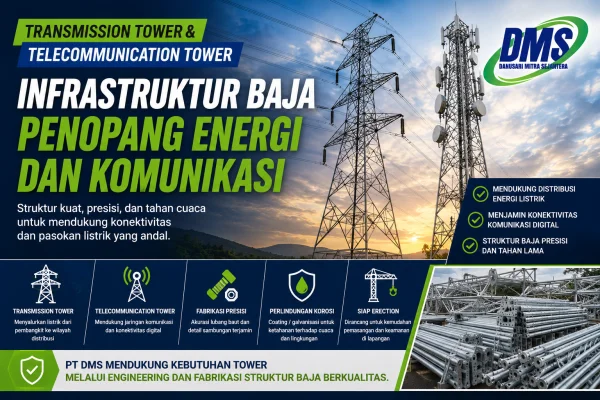
Transmission Tower and Telecommunication Tower: Steel Infrastructure Supporting Energy and Digital Connectivity
In the modern era, the need for a stable electricity supply and reliable communications networks continues to increase. The growth of industrial areas, city development, internet network expansion, and the development of digital technology all depend on infrastructure that is able to connect resources with society. Two elements that play an important role in the system are transmission tower And telecommunication tower.
Even though they have different functions, these two types of towers are similar in terms of construction. Both rely on steel structures that are strong, precise, and resistant to various environmental conditions. Starting from the design process, fabrication, to installation in the field, each stage must meet strict technical standards so that the tower is able to operate safely in the long term.
Transmission Tower Maintains Electrical System Reliability
A transmission tower or transmission tower is a structure used to support high voltage overhead lines (SUTT) or extra high voltage overhead lines (SUTET). Its main function is to distribute electrical energy from the generator to the substation, then forwarded to the distribution network until it reaches consumers.
The existence of a transmission tower is an important part of the national electricity system. Without this structure, the process of distributing electricity over long distances would be difficult to carry out efficiently. Therefore, the tower design must be able to support the weight of conductors, insulators, as well as various additional loads that arise due to wind, rain, or changes in temperature.
Apart from having a high load capacity, transmission towers must also be designed to remain stable even in areas with diverse geographical conditions, such as mountains, swamps, coastal areas, or areas with high levels of wind activity. These factors are the basis for determining the structural configuration and dimensions of each steel component used.
Telecommunication Tower Supports Digital Connectivity
If the transmission tower functions to distribute electrical energy, then telecommunication tower acts as a support for various telecommunications devices that enable people to enjoy modern communication services.
Telecommunication towers are used to install antennas, microwave links, radio devices, and cellular network equipment that supports 4G, 5G services, broadband internet and various other communication systems. This infrastructure is the main foundation for supporting digital transformation in various sectors, from government, education, health, industry, to financial services.
As the need for connectivity increases, the number of telecommunication towers also continues to increase. Apart from reaching urban areas, tower construction is now increasingly being carried out in remote areas so that equal communication access can be achieved.
Because they are in open space all the time, telecommunications towers must have structures that are able to withstand antenna loads, wind pressure, vibrations and weather changes without reducing the stability of the construction. Therefore, the quality of steel structures is one of the main factors that determines the reliability of communication networks.
Steel Structure is the Main Material for Infrastructure Towers
Both transmission towers and telecommunication towers almost entirely use steel structures as the main material. Steel selection is based on a combination of superior mechanical properties, such as high strength, relatively light weight compared to its load capacity, and ease in the fabrication and installation process.
Most towers use a steel frame system (lattice structure) which consists of various profile bars connected to each other using bolted connections. This configuration is able to distribute the load efficiently so that the tower remains stable even though it has a height of tens to hundreds of meters.
Apart from being strong, steel structures also provide flexibility in the production process. Components can be fabricated in the workshop with a high level of precision before being sent to the project site to be assembled through the erection process. This approach helps speed up construction time while maintaining the quality of each structural element.
Fabrication Accuracy Determines Smooth Installation
The success of tower construction is not only determined by the quality of the design, but also by accuracy during the fabrication process. Each component must be produced according to shop drawings with precise sizes, bolt hole positions and connection details.
In steel towers, the number of bolts used can reach thousands of connection points. If there is an error in the position of the hole or a dimensional mismatch in one of the components, the erection process can experience obstacles which can result in project delays.
Therefore, the fabrication process must be supported by an accurate measurement system, the use of high-precision production machines, and quality inspection at every stage. Checking dimensions, welding quality, component marking, and checking conformity with shop drawings are important parts in ensuring that all elements are ready to be installed in the field.
With precise fabrication, the erection process can take place more quickly, safely, and with minimal rework.
Corrosion Protection to Guarantee Service Life
Infrastructure towers are generally installed in open areas so they are constantly exposed to rain, hot sun, humidity, wind, and even corrosive environments such as coastal or industrial areas. Therefore, protection against corrosion is an aspect that cannot be ignored.
Before the finishing process is carried out, the steel surface is cleaned via sandblasting to remove rust, mill scale and various contaminants that can reduce the adhesion of the protective layer. After that, the components are given a coating or galvanization system according to project specifications so that they have better resistance to corrosion.
Proper surface protection can extend the life of the structure, reduce the frequency of maintenance, and maintain tower performance for many years. This step also helps reduce long-term operational costs because the risk of damage due to corrosion is reduced.
Erection Readiness is a Determining Stage for Project Success
After all components have been produced and checked, the next stage is erection or installation at the project site. This process requires good coordination between the engineering, fabrication, logistics and field teams.
Components that have been given an identification code will be installed in the planned order. Dimensional accuracy, connection quality and material readiness will greatly influence the speed and safety of the erection process.
Apart from that, tower installation must also consider weather conditions, lifting methods, heavy equipment capacity, and work safety procedures. With careful planning, the erection process can run more efficiently while minimizing risks in the field.
PT DMS Commitment in Supporting Steel Tower Infrastructure
As a company engaged in steel structure fabrication, PT Danusari Mitra Sejahtera (PT DMS) supporting the construction of transmission towers and telecommunication towers through engineering and fabrication processes that prioritize quality, precision and compliance with technical standards.
Each component is produced by paying attention to dimensional accuracy, connection quality, bolt hole position, and a surface protection system that suits project needs. All production stages are also supported by an inspection and quality control process to ensure components are ready to be shipped and installed on site.
With experience in various steel infrastructure projects, PT DMS is committed to providing fabrication solutions that are able to support the development of energy and communications networks in Indonesia. Through steel structures that are strong, precise and resistant to various environmental conditions, PT DMS continues to contribute to creating more reliable, safe and sustainable infrastructure.
PT. Danusari Mitra Sejahtera remains committed to delivering the best service to our clients. With over 19 years of experience in steel construction and fabrication, we support national infrastructure projects.
"Quality is our top priority in every project we deliver."
For more information about our products and services, please contact our team.