Cross-Sector Experience: The Key to Producing the Right Steel Fabrication Solution for Every Project
In the steel construction industry, each project has different characteristics and challenges. Bridge structures certainly have technical requirements that are not the same as mining structures, storage tanks, towers or industrial buildings. Therefore, experience working on various types of projects is one of the important values that a steel fabrication company must have.
Extensive experience not only shows the number of projects that have been carried out, but also reflects the company's ability to understand the technical needs of each sector. Starting from the engineering process, material selection, fabrication, quality control, to delivery and erection, all stages must be adjusted to the characteristics of the project in order to produce a structure that is safe, efficient and has a long service life.
Experience is an asset in facing various project challenges
Each industry sector has different standards, specifications and challenges. Fabrication companies that have experience in various types of projects generally have a better ability to identify potential obstacles from the planning stage.
This experience helps the engineering team determine the most appropriate solution based on field conditions, structural capacity, installation methods, and operational needs after the project is completed. In this way, various risks can be minimized before the production process begins.
Apart from that, experience also speeds up the coordination process with consultants, contractors and project owners because the company understands the work flow and standards commonly applied in various construction sectors.
Bridges and Infrastructure Require High Precision
Bridge and infrastructure projects demand a very high level of accuracy. Each component must be produced according to shop drawings so that it can be assembled without problems in the field.
In bridge projects, for example, dimensional accuracy, bolt hole positions, welding quality, and protection against corrosion are the main factors that determine the success of the erection process. The slightest error can affect the installation process and increase the risk of rework.
Likewise, in various infrastructure projects such as roads, flyovers and public facilities, steel structures must be able to provide strength, durability and reliability in the long term. Therefore, experience in this sector is an important provision in producing components that meet technical standards.
Mining and Industry Require Resilient Structures
Mining environments are known to have harsh working conditions. Steel structures must be able to withstand large loads, machine vibrations, exposure to dust, humidity and extreme weather conditions.
Conveyor systems, support frames, maintenance platforms, and coal handling structures require a different engineering approach compared to ordinary building structures. Apart from being strong, the design must also facilitate the inspection and maintenance process so that mining operations continue to run without interruption.
In the industrial sector, structural needs are also very diverse, ranging from factories, warehouses, production facilities, to other supporting buildings. Experience in this sector helps companies understand the specific needs of each facility so that the solutions provided are more effective.
Storage Tanks and Towers Have Special Standards
Storage tank, transmission tower and telecommunication tower projects have more specific technical requirements. Storage tanks must be designed based on capacity, fluid type, working pressure, and applicable safety standards.
Meanwhile, transmission and telecommunications towers must be able to withstand wind loads, vibrations and various environmental conditions for decades. Accuracy in connection details, accuracy of bolt holes, and protection against corrosion are aspects that cannot be ignored.
Experience in handling these projects allows the company to understand design requirements, fabrication methods, and inspection processes in accordance with industry standards.
Integrated Engineering is the Foundation of Every Project
The success of a steel construction project always begins with a mature engineering process. The engineering team is tasked with translating project requirements into designs, structural calculations, shop drawings, connection details and material specifications that are ready to be produced in the workshop.
In companies that have handled various sectors, the engineering process becomes more effective because it is supported by experience in solving various technical challenges. This allows the resulting design to not only meet strength aspects, but also consider material efficiency, ease of fabrication, and the most suitable erection method.
An integrated engineering approach also makes it easier to coordinate with the production team, quality control and field teams so that each stage of work runs more harmoniously.
Fabrication that Adapts the Character of the Project
Each project requires a different fabrication approach. Components for bridges have different details from mine structures, storage tanks, or towers.
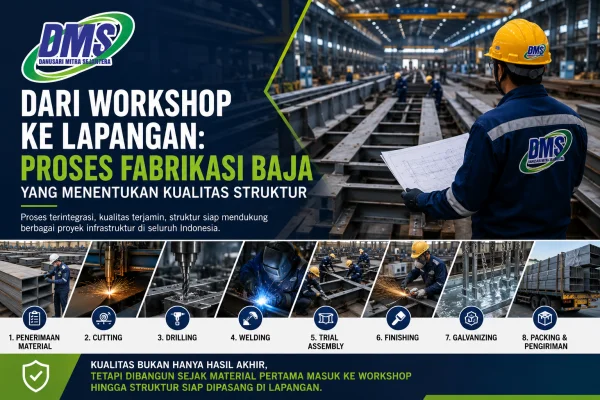
Therefore, the production process must be able to adjust cutting, forming, rolling, drilling, welding and finishing methods according to the specifications of each project. The quality control system also needs to be implemented consistently so that each component meets the standards for dimensions, connection quality and surface protection.
With experience in various sectors, the fabrication process becomes more focused because each stage takes into account the final requirements of the structure to be used.
Coordination Determines Smooth Delivery and Erection
The success of the project does not stop after the production process is complete. Packing, labeling, bundling, loading plans, and delivery coordination are important parts so that components arrive at the project site in good condition and ready to be installed.
In addition, the erection method must be considered from the engineering stage so that component sizes, lifting points and installation sequences can be carried out efficiently. Good coordination between engineering, production, quality control, logistics and field teams will speed up project completion while reducing the risk of errors during installation.
PT DMS Commitment to Support Various Industrial Sectors
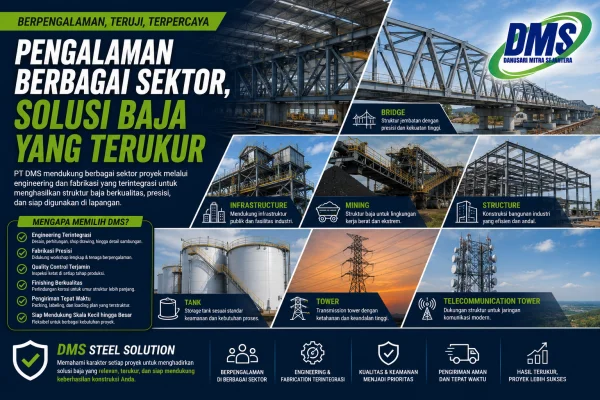
As a company engaged in steel structure fabrication, PT Danusari Mitra Sejahtera (PT DMS) has experience in supporting various sectors, ranging from bridge, infrastructure, mining, structure, storage tank, transmission tower, telecommunication tower, to various other industrial components.
Through an integrated engineering and fabrication process, PT DMS presents solutions that are tailored to the characteristics of each project. Each stage is carried out by prioritizing quality, precision, safety and efficiency so that the resulting components are ready for use in the field.
By understanding the technical challenges in each sector, PT DMS continues to strive to provide steel construction solutions that are relevant, scalable and reliable for various project needs, both small and large scale. This commitment is part of efforts to provide quality work results and support the success of infrastructure and industrial development in Indonesia.
PT. Danusari Mitra Sejahtera remains committed to delivering the best service to our clients. With over 19 years of experience in steel construction and fabrication, we support national infrastructure projects.
"Quality is our top priority in every project we deliver."
For more information about our products and services, please contact our team.