The Importance of Safe Packing and Shipping for Large Steel Components
In the steel fabrication industry, product quality is not only determined by the engineering and production processes in the workshop. The stages after fabrication, namely packing, material handling, and delivery to the project site, have an equally important role in ensuring that each component arrives in good condition and ready to be installed. Large steel components generally have various dimensions, weights and shapes, so they require careful logistics planning.
A delivery process that is not carried out correctly has the potential to cause damage to components, project delays, and increased costs due to repairs or replacement of materials. Therefore, every stage starting from packing, labeling, bundling, cargo preparation, to coordination with the project team must be carried out systematically so that the entire process runs safely and efficiently.
Proper Packing Protects Components During Shipping
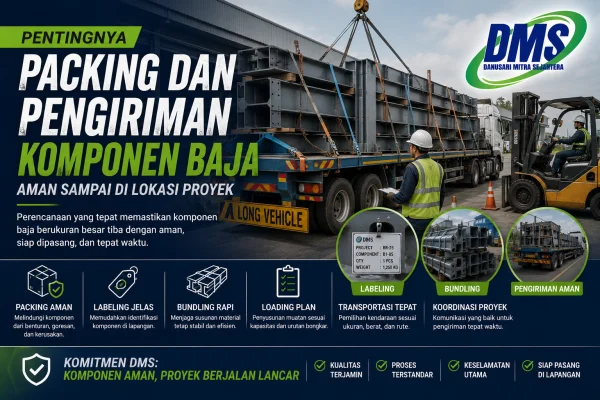
Packing is the first step to protect steel components from the risk of damage during the transportation process. Even though steel is known as a strong material, the surface of components can still experience scratches, deformation or damage to certain parts if handled improperly.
The packing method is adjusted to the type of component, size, shape, and transportation method to be used. For certain components, wooden pads, separators, corner protectors or other supporting materials are used to prevent direct impacts during travel.
Apart from physical protection, packing also considers the stability of the component's position when the vehicle passes through bumpy roads or makes sudden braking. Good arrangement will reduce material movement so that the risk of damage can be minimized.
In projects with high-value components or high levels of precision, packing becomes an important part of maintaining the quality of the fabricated results until they arrive at the installation site.
Labeling makes it easier to identify at the project location
After the packing process is complete, each component needs to be delivered labelling or clear identification. This label usually contains information such as component number, shop drawing code, installation position, and relevant project information.
The existence of labeling really helps the field team to recognize each component without having to re-inspect them one by one. On large-scale projects, the number of steel components can reach thousands of units, so an accurate identification system is an important factor in speeding up the erection process.
Apart from speeding up the search for materials, labeling also reduces the risk of installation errors. Components that have been coded according to the shop drawing will be immediately placed in the planned position so that the work becomes more efficient.
In modern project management systems, labeling is often combined with barcodes or QR codes to simplify the process of tracking materials from the time they leave the workshop until they are received at the project site.
Bundling Keeps Materials Neat and Safe
Apart from labeling, processing bundling is also an important part in handling steel components. Bundling is a method of grouping several components that have the same size, function or installation location into one package.
This method provides various benefits, especially in simplifying the process of loading, unloading and distributing materials in the field. The logistics team does not need to look for components separately because all interrelated parts are packaged in one group.
Bundling also helps maintain material stability during the lifting process using a crane or forklift. With a neat arrangement and strong ties, the risk of components shifting or falling during the handling process can be reduced.
Apart from improving safety aspects, bundling also helps save time during the loading and unloading process so that the delivery schedule can run according to plan.
Loading Plan Determines Transportation Security
Successful delivery of steel components depends not only on good packing, but also on loading plan the mature one. Loading plan is a plan regarding how each component will be arranged on the vehicle so that the load distribution remains balanced and safe.
Large components must be placed taking into account the center of gravity, vehicle dimensions, carrying capacity, and the order of dismantling at the project site. Improper placement can cause the vehicle to lose balance or make the unloading process difficult.
In addition, each component must be fastened using an appropriate securing system so that it does not shift during transportation. The use of chains, webbing slings and special ties is based on the weight and shape of the material being transported.
A good loading plan also pays attention to operational efficiency. The arrangement of materials is adjusted to the order of installation in the field so that the components needed first can be unloaded first without disturbing other loads.
Vehicle Selection and Coordination Are Important Factors
Delivery of large steel components requires a vehicle that is suitable for the dimensions and weight of the material. Trailers, lowbeds, and special vehicles are often used to transport steel structures that have a certain length or weight.
Vehicle selection must consider the carrying capacity, size of the road to be traversed, bridge height, road load limits, and terrain conditions leading to the project location. On some projects, deliveries even require special escorts or certain timings so as not to disrupt traffic.
Coordination between the workshop team, logistics department, transportation company and project team is also a very important factor. Information regarding delivery schedules, site conditions, readiness of unloading equipment, and erection sequences must be communicated well to avoid delays or accumulation of material in the field.
Good collaboration between all parties will help ensure the delivery process is safe, efficient and in accordance with the project schedule.
Logistics Safety Supports Project Smoothness
The safety aspect is the main priority in every steel component logistics process. Starting from the lifting process in the workshop, securing the load, traveling to the project location, to unloading materials, you must follow established work procedures.
Every handling activity using a crane, forklift or other lifting equipment must pay attention to the capacity of the equipment, lifting point and working environment conditions. Inspection of slings, shackles, spreader beams and other lifting equipment is also an important part of preventing work accidents.
By implementing good safety procedures, the risk of material damage and potential accidents during the logistics process can be reduced to a minimum. This not only maintains component quality, but also helps the project run on time and cost targets.
PT. Danusari Mitra Sejahtera remains committed to delivering the best service to our clients. With over 19 years of experience in steel construction and fabrication, we support national infrastructure projects.
"Quality is our top priority in every project we deliver."
For more information about our products and services, please contact our team.