Storage Tanks: Critical Infrastructure for Safe and Reliable Fluid Storage
Storage tanks are an important component in various industrial sectors. This facility is used to store various types of fluids, ranging from water, industrial raw materials, chemicals, oil, gas, to products resulting from production processes. The existence of a storage tank allows operational processes to run more efficiently because materials can be stored safely before being used, further processed, or distributed.
Even though it looks simple from the outside, a storage tank is a structure designed through a complex engineering process. Each tank must be able to withstand fluid loads, internal pressure, environmental influences, and meet various applicable safety standards. Therefore, the storage tank design and fabrication process requires a high level of precision to be able to provide optimal performance during its operational period.
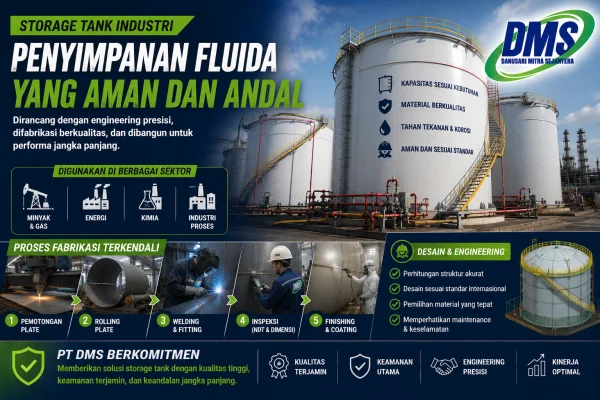
Storage Tanks Are Used in Various Industrial Sectors
Storage tanks have an important role in almost all modern industrial sectors. In the oil and gas industry, tanks are used to store crude oil, fuel, and various processing products before being distributed to consumers. In the energy sector, storage tanks are used to store generator fuel, process water and operational support fluids.
Meanwhile, the chemical industry uses storage tanks to store raw materials and final products that have different characteristics. In the manufacturing sector, tanks are used to store process water, cooling fluids, and production raw materials. Even in the food and beverage processing industry, storage tanks are an important part of maintaining product quality during the production process.
This variety of functions means that each storage tank must be designed according to the specific needs of the industry that uses it. No one design can be applied to all applications because the characteristics of the deposited materials can vary greatly.
Storage Tank Design Must Be Adapted to Operational Needs
The engineering stage is the main foundation in building a storage tank. Before the fabrication process begins, the engineering team will conduct an analysis of various operational requirements so that the resulting design is able to work safely and efficiently.
Storage capacity is one of the first parameters determined. The size of the tank volume will affect the dimensions of the structure, the thickness of the steel plate, the foundation system, and the fabrication method used.
Apart from capacity, the type of fluid to be stored is also a very important factor. Fluids with corrosive, flammable, pressurized or high temperature properties require different materials and protection systems than ordinary fluids.
The construction location also influences the storage tank design. Tanks located in coastal areas, industrial areas with chemical exposure, or areas with high earthquake activity require additional engineering considerations to remain safe during the operational period.
Capacity, Pressure, and Material Determine Tank Safety
Each storage tank is designed based on the working conditions it will face. Atmospheric tanks have different requirements than pressure tanks, and water tanks have different specifications to chemical storage tanks.
Engineers must calculate hydrostatic pressure due to fluid weight, wind loads, earthquake loads, and possible temperature changes that can affect the structure. This calculation is the basis for determining the thickness of the shell plate, roof plate, bottom plate, and stiffener system.
Material selection also cannot be done haphazardly. Carbon steel, stainless steel or special materials are selected according to the characteristics of the media to be stored. The goal is to ensure the tank is resistant to corrosion, pressure and environmental conditions so that it can operate safely in the long term.
Maintenance Access and Safety Standards are a Priority
Apart from structural strength, storage tanks must also be designed to be easy to inspect and maintain. Therefore, various supporting facilities such as platforms, access stairs, handrails, nozzles, manholes, and ventilation systems are an important part of tank design.
The existence of maintenance access makes it easier to carry out periodic inspections, cleaning the inside of the tank, and maintenance work without compromising worker safety. This is very important because storage tanks generally operate for a long time and require regular checks so that their performance remains optimal.
On the other hand, all designs must comply with applicable safety standards, such as API, ASME, or other international standards according to the type of tank and application. Implementation of these standards helps ensure that storage tanks are able to operate with a high level of safety throughout their lifetime.
Storage Tank Fabrication Requires High Precision
After the engineering process is complete, the next stage is fabrication. Making storage tanks requires high precision because each component must be produced according to shop drawings so that the assembly process runs smoothly.
The process begins with cutting the plate using a high-precision machine according to the planned size. Next, the steel plate goes through a rolling process to form an arch that matches the diameter of the tank.
The fitting stage is carried out to ensure each component is in the right position before the welding process begins. All joints are then welded following predetermined welding procedures to produce strong and consistent joint quality.
Accuracy at each stage is very important because small errors can affect the shape of the tank, the quality of the connections, and the overall performance of the structure.
Inspection and Finishing Guarantee Long Term Reliability
The quality of storage tanks is not only determined by the fabrication process, but also by the inspection system carried out during production. Dimensional inspection, welding quality, and Non-Destructive Test (NDT) are important parts of ensuring that there are no defects that could reduce the safety of the tank.
Apart from inspection, the finishing process also plays a big role in increasing the service life of the structure. The steel surface is cleaned via sandblasting before being given a coating system that is appropriate to the environmental conditions and media to be stored.
This protective layer helps prevent corrosion, maintains the appearance of the tank, and reduces the need for long-term maintenance. With a combination of precise fabrication and quality finishing, storage tanks can provide more reliable performance for years.
PT. Danusari Mitra Sejahtera remains committed to delivering the best service to our clients. With over 19 years of experience in steel construction and fabrication, we support national infrastructure projects.
"Quality is our top priority in every project we deliver."
For more information about our products and services, please contact our team.