Fabrication Accuracy as the Foundation of Steel Construction Quality
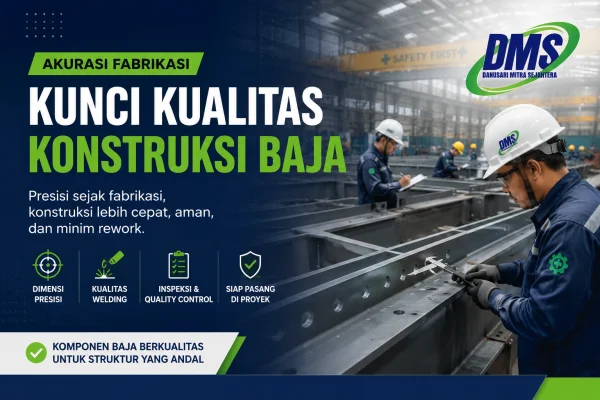
In the steel construction industry, the success of a project is not only determined by the quality of the design or the ability of the installation team in the field. One factor that has a very big influence is accuracy at the fabrication stage. The fabrication process is a stage where steel material is cut, shaped, perforated, assembled and welded according to shop drawings. The entire process must be carried out with a high level of precision so that each component can be installed without problems when it arrives at the project site.
The slightest error at the fabrication stage can have a chain impact. A difference of a few millimeters in the dimensions or position of the bolt holes can cause the components not to be assembled properly. As a result, erection work takes longer, project costs increase, and even the quality of the structure can be compromised if modifications are made that do not comply with procedures. Therefore, fabrication accuracy is the main foundation in producing steel construction that is safe, efficient and in accordance with technical specifications.
The Importance of Accurate Dimensions and Bolt Hole Position
Each steel component is produced based on dimensions that have been calculated in detail by the planning team. Dimensional accuracy is the main requirement so that all structural elements can be connected to each other properly. Beams, columns, bracing and connection plates must have the appropriate size so that the installation process runs smoothly without the need for additional adjustments in the field.
Apart from dimensions, the position of the bolt holes also plays a very important role. Bolted connections are one of the most widely used methods of connecting steel structures because they are able to provide high strength while simplifying the installation process. However, these benefits can only be obtained if each hole is produced with a precise position.
Incompatibility of the hole position often causes the bolt to not be installed or requires a hole enlargement process which is not actually recommended. This action has the potential to reduce connection performance and increase job time. Therefore, the drilling and cutting process using CNC machines and precision measuring tools is an important part in maintaining the quality of fabrication results.
Welding Quality Determines the Strength of the Structure
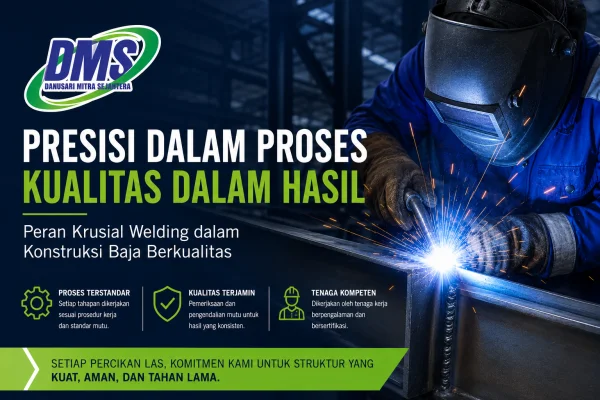
Apart from the dimensions and position of the connection, the quality of the welding is an aspect that cannot be ignored. Welding functions to unite several components into a single structural unit that is able to withstand various types of loads during the operational period of the building.
Good weld results must meet certain technical standards, starting from weld size, penetration, to surface cleanliness. Welding that does not comply with procedures can cause defects such as cracks, porosity, undercuts, or incomplete fusion which have the potential to reduce the strength of the connection.
To maintain this quality, the welding process is generally carried out by certified welders by following the Welding Procedure Specification (WPS). After the process is complete, the welded joints are also checked using visual inspection or the Non-Destructive Test (NDT) method according to project requirements. This step ensures that each connection is of a quality that meets safety standards and is able to perform optimally throughout the service life of the structure.
Conformity with the Shop Drawing is the Key to Precision
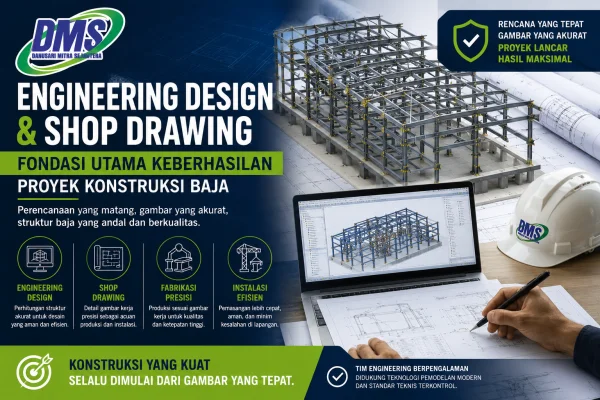
Shop drawings are technical documents that are the main reference during the fabrication process. All sizes, connection details, material types, and component codes have been specified in detail in the drawing. Therefore, each production stage must refer to the shop drawing so that the final result is in accordance with the plan.
Consistency in following shop drawings helps minimize production errors that can hamper the construction process. Apart from that, conformity to working drawings also makes it easier to identify components during delivery and installation at the project site.
On large-scale projects, the number of steel components can reach thousands of units with different shapes. An accurate marking system and compliance with shop drawings are important factors so that all components can be assembled in the planned sequence.
Impact of Fabrication Accuracy on the Erection Process
The greatest benefits of precision fabrication will be seen when the erection process begins. Components manufactured with a high level of accuracy can be installed directly without requiring additional modifications in the field. This makes work faster, safer and more efficient.
On the other hand, if discrepancies in dimensions or connections are found, the erection team must make various adjustments which require additional time, energy and costs. In some cases, components even have to be returned to the workshop for repair, resulting in delays in the project schedule.
Rework not only increases operational costs, but also has the potential to disrupt coordination between other jobs at the project site. Therefore, investing in a precision fabrication process is actually a preventive step that can save overall project costs.
The Role of Measurement, Inspection, and Quality Control
To ensure all components meet specified standards, each fabrication stage needs to be supported by a strict measurement and inspection system. Inspections are carried out from the time the material arrives at the workshop, during the production process, until before the components are sent to the project location.
The Quality Control (QC) team is responsible for verifying dimensions, checking bolt hole positions, inspecting welding quality, and ensuring material specifications comply with project documents. Various precision measuring tools such as steel tape, digital caliper, total station, and laser measuring tools are used to obtain accurate measurement results.
Apart from dimensional checks, documentation of inspection results is also an important part of the quality control system. This data serves as proof that the entire process has been carried out according to standards and makes the tracking process easier if obstacles are found at the next stage.
PT DMS Commitment to Maintaining Fabrication Standards
As a company engaged in steel structure fabrication, PT DMS understands that product quality starts from a controlled production process. Therefore, each fabrication stage is carried out by prioritizing accuracy, compliance with shop drawings, and consistent implementation of quality control procedures.
This commitment is realized through the use of production equipment that supports a high level of precision, competent workforce, and a multi-layered inspection system. This approach aims to ensure that every component delivered to the project site is in ready-to-install condition and meets the required technical specifications.
By maintaining fabrication accuracy from the start, the risk of errors during erection can be reduced to a minimum. The result is a more efficient construction process, a more controlled project completion time, and steel structures that have quality, safety and reliability according to plans. Accuracy is not just a technical measure, but an important investment to produce a successful steel construction project and provide long-term value for all parties involved.
PT. Danusari Mitra Sejahtera remains committed to delivering the best service to our clients. With over 19 years of experience in steel construction and fabrication, we support national infrastructure projects.
"Quality is our top priority in every project we deliver."
For more information about our products and services, please contact our team.