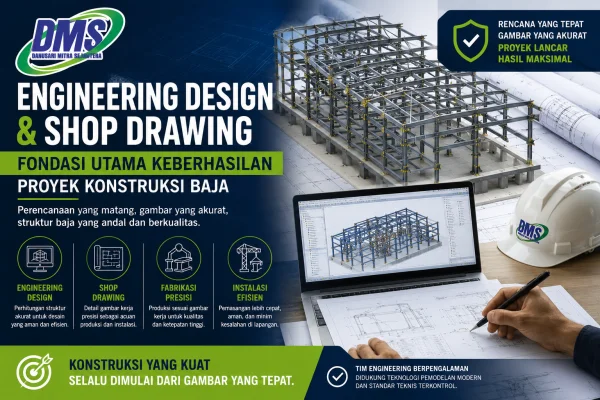
Engineering Design and Shop Drawing: The Main Foundation of Successful Steel Construction Projects
In any steel construction project, a strong, quality finish does not happen by accident. Behind a structure that stands firmly there is a planning process that is mature, measurable and well documented. One of the most important stages in the process is preparation Engineering Design And Shop Drawing.
Even though they are often behind the scenes, these two documents have a very important role in determining the success of the project. Engineering Design and Shop Drawing become a bridge between the planning concept and the production process in the workshop and installation in the field. Without accurate working drawings, the risk of production errors, project delays and cost overruns can increase significantly.
For this reason, in the modern steel construction industry, the quality of a structure is not only determined by the material and fabrication process, but also by the quality of the underlying planning.
Understanding the Role of Engineering Design
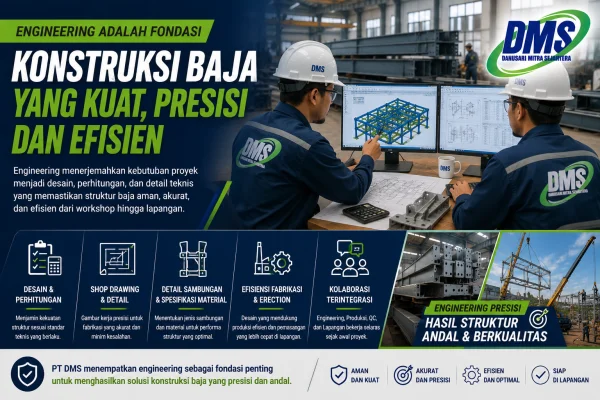
Engineering Design is a technical planning process that translates project requirements into a structural design that is safe, efficient and meets standards. At this stage, the engineering team carries out various analyzes to ensure that the structure is able to withstand all the loads that will work during its operational period.
Calculations are carried out on various factors such as dead load, live load, wind load, earthquake load, as well as environmental conditions that the structure will face. The results of the analysis are then poured into a design drawing which becomes the basis for the entire subsequent process.
Engineering Design not only focuses on structural strength, but also considers aspects of material efficiency, ease of fabrication, ease of installation, and overall construction costs. With the right approach, the resulting design is able to provide a balance between safety, function and project efficiency.
Shop Drawing as a Production Guide
After the design is approved, the next stage is preparing the Shop Drawing. This document contains detailed working drawings that are used as a reference in the fabrication and installation process of the structure.
Shop Drawings contain much more detailed information than general design drawings. The details displayed include component dimensions, material specifications, bolt hole positions, welding connection details, component codes, and assembly sequence. All this information is compiled systematically so that it can be understood by the production team, quality control and erection teams in the field.
By having a complete and accurate Shop Drawing, every party involved in the project has the same reference. This helps reduce the potential for misinterpretation which often causes problems in project implementation.
Reducing the Risk of Mistakes From the Start
One of the biggest benefits of Engineering Design and Shop Drawing is its ability to identify potential problems before the production process begins.
Through the process of reviewing and verifying drawings, possible design conflicts can be discovered early. For example, dimensional discrepancies, clashes between components, incorrect connection positions, or non-compliance with field conditions.
Repairs made at the design stage are certainly much more efficient than if the problem was only discovered during fabrication or installation. Therefore, a good engineering process can help save time, costs, and overall project resources.
This approach also provides a higher level of certainty regarding the quality of the final results that will be achieved.
Increasing the Effectiveness of Inter-Division Coordination
Steel construction projects involve various parties with different functions. Starting from the engineering team, procurement, production, quality control, logistics, to the erection team in the field. Without good coordination, the project implementation process can experience obstacles that impact schedule and costs.
Shop Drawing functions as a technical communication medium that unites all divisions. Every important information regarding the structure can be accessed and understood based on the same document.
Thus, coordination between divisions becomes more effective. The production team knows the components that must be made, the quality control team understands the inspection parameters that must be carried out, while the erection team has clear guidelines for the installation process in the field.
Harmonization of this information is an important factor in maintaining the smooth running of the project from start to finish.
Supports Precision Fabrication
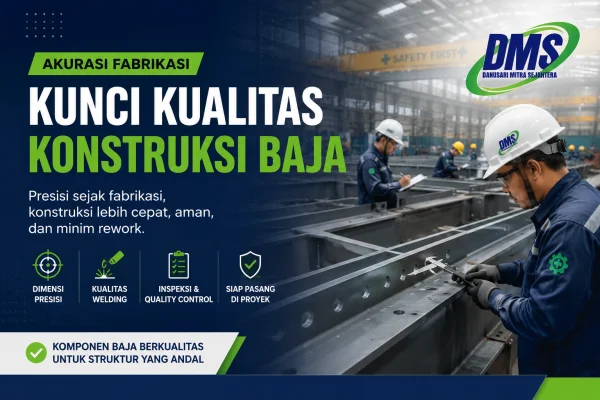
In the steel fabrication process, accuracy is a very important factor. An error of just a few millimeters can cause major problems during the assembly process.
Through detailed Shop Drawings, each component can be produced according to predetermined sizes and specifications. Cutting, drilling, forming and welding processes can be carried out with a high level of precision.
The result is a component that has good dimensional compliance and is ready to assemble without requiring much additional adjustment. This not only improves product quality, but also speeds up the overall production process.
Precision fabrication will ultimately have a positive impact on the quality of the structure being built.
Speeds up installation in the field
Another advantage of careful planning is the acceleration of the installation process in the field. When all components have been produced according to the correct working drawings, the erection process can be carried out more efficiently.
The field team does not need to make many modifications or adjustments because all details have been verified since the engineering stage. Components can be installed directly according to the planned sequence.
Apart from increasing productivity, this condition also helps reduce the risk of work accidents which often occur due to improvised work in the field. In this way, safety and efficiency aspects can run simultaneously.
Technology Support in Modern Engineering Processes
Technological developments have brought major changes to the world of engineering and steel construction. Currently, designing and shop drawings are no longer done manually, but using sophisticated modeling and design software.
This technology allows visualization of structures in more detail, accuracy and is easy to evaluate before entering the production stage. Apart from increasing accuracy, the use of technology also helps speed up the revision process and coordination between teams.
At PT Danusari Mitra Sejahtera, every Engineering Design and Shop Drawing is prepared by an experienced engineering team supported by modern modeling technology and controlled technical standards. This approach ensures each project has a solid planning foundation before entering the fabrication and construction phase.
Conclusion
The success of a steel construction project is not only determined by the quality of the materials and fabrication process, but also by the quality of planning carried out from the start. Engineering Design and Shop Drawing are the main foundations that ensure each component is produced and installed according to predetermined specifications.
Through accurate working drawings, coordination between divisions becomes more effective, the risk of errors can be minimized, and the fabrication and installation process can run more quickly, safely and efficiently. Therefore, investing in quality engineering processes is an important step to produce reliable and long-lasting steel structures.
Because in the end, strong construction always starts with the right drawings.
PT. Danusari Mitra Sejahtera remains committed to delivering the best service to our clients. With over 19 years of experience in steel construction and fabrication, we support national infrastructure projects.
"Quality is our top priority in every project we deliver."
For more information about our products and services, please contact our team.