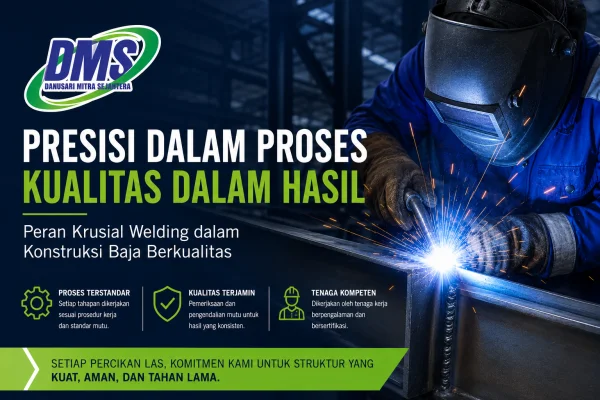
Precision in Every Joint: The Crucial Role of Welding in Quality Steel Construction
In the steel construction industry, the strength of a structure is not only determined by the quality of the materials used. Even steel with the best specifications will not be able to provide optimal performance if the joints connecting it are not made to the right standards. Therefore, the welding process or welding is one of the most important stages in the entire steel fabrication process.
Every bridge, tower, storage tank, industrial building, and various other steel structures consist of hundreds or even thousands of connection points. The quality at each point will greatly determine the structure's ability to withstand loads, face environmental conditions, and maintain safety during its operational period. That's why the welding process requires high precision, skill and quality control.
Why is the Welding Process So Important?
Welding is the process of connecting two or more metal components using heat and certain techniques so that a strong and permanent bond is formed. In steel construction, welded joints serve as the main fastening element that ensures all parts of the structure work as one unit.
Connections that are made correctly are able to distribute the load evenly throughout the structure. On the other hand, small errors in the welding process can create weak points that have the potential to cause cracks, deformation and even structural failure. Therefore, welding cannot be viewed as just a process of joining materials, but as an important part of the construction safety and reliability system.
In various infrastructure and industrial projects, the quality of welding results is often one of the main indicators in assessing the overall quality of steel fabrication work.
Important Stages in the Welding Process
To produce quality connections, the welding process must be carried out through several planned and controlled stages. The first stage starts from material preparation. The steel surface must be cleaned of dirt, oil, rust, or other contaminants that can interfere with the quality of the connection.
After that, the process is carried out fit-up, namely the alignment and placement of components before welding. This stage is very important because inaccurate material positioning can cause dimensional discrepancies and affect the quality of the final joint.
The next stage is the welding process itself. At this stage, parameters such as electric current, welding speed, electrode type, and work techniques must be controlled according to established procedures. Welding that is carried out consistently will produce good penetration, appropriate joint shape, and optimal strength.
Once the welding process is complete, the work is not immediately considered complete. Connections must undergo various inspection and verification processes to ensure that the results meet the required technical specifications.
Quality Control to Ensure Reliability
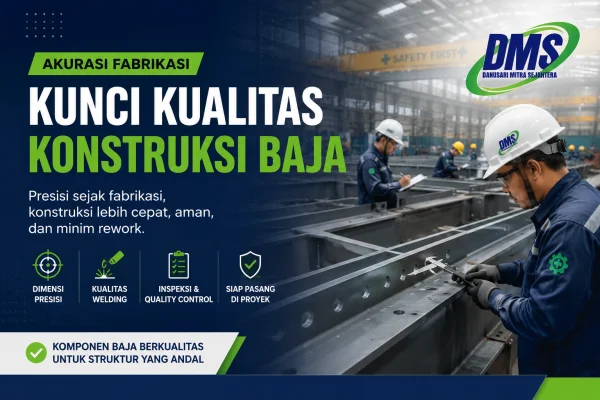
In modern steel fabrication, quality control is an inseparable part of the welding process. Inspections are carried out to ensure that each connection is free from defects that could affect the performance of the structure.
One common method is visual inspection. Through this inspection, the quality control team can identify various potential non-conformities such as porosity, undercuts, surface cracks, or weld shape irregularities.
In addition to visual inspection, certain projects also require advanced testing using non-destructive methods to ensure the quality of the inside of the joint without damaging the material. This step is an important part of maintaining consistent quality and increasing the level of confidence in the fabrication results.
With a good quality control system, potential risks can be minimized early on so that the resulting structure has a higher level of safety and durability.
DMS Commitment to Welding Quality
At PT Danusari Mitra Sejahtera (DMS), the welding process is carried out by competent and experienced workers. Each job refers to work procedures and quality standards that have been established to ensure consistent results on each project.
All stages, from material preparation, fit-up, welding, to final inspection, are carried out with a systematic and documented approach. The production and quality control teams work in an integrated manner to ensure that each connection meets the technical requirements specified by the project and customer.
This commitment is part of the company's work culture in producing steel products and structures that not only meet specifications, but are also able to provide reliable long-term performance.
Conclusion
In steel construction, the quality of welded joints plays as important a role as the quality of the material itself. Through precise welding processes, strict quality control, and competent labor, a structure can be built with a high level of strength, safety, and reliability.
For PT Danusari Mitra Sejahtera, every welding spark has more meaning than just the process of joining steel. Each connection is part of a commitment to provide strong, safe and durable structures for various infrastructure and industrial needs.
Precision in the process. Quality in results.
PT. Danusari Mitra Sejahtera remains committed to delivering the best service to our clients. With over 19 years of experience in steel construction and fabrication, we support national infrastructure projects.
"Quality is our top priority in every project we deliver."
For more information about our products and services, please contact our team.