Guardrail System: Important Protection to Improve Road Safety
Road safety is an important aspect in the development of modern transportation infrastructure. So far, many people think that driving safety only depends on traffic signs, road markings, or road users' compliance with regulations. In fact, there are various supporting elements that play a big role in minimizing the impact of accidents when incidents cannot be avoided. One of these elements is Guardrail System.
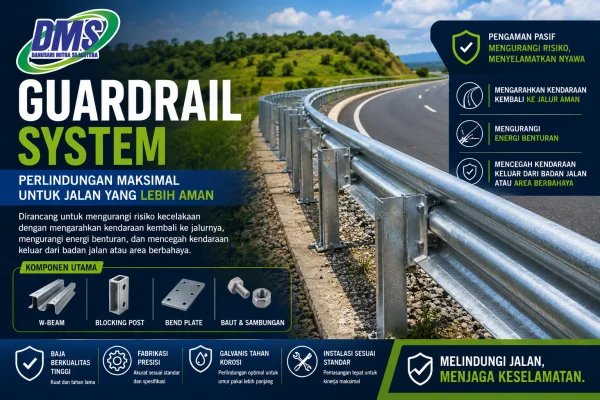
Guardrail is a road safety system designed to protect road users from greater risks due to accidents. The existence of guardrails not only functions as a physical barrier, but also as a passive safety system that can reduce the severity of collisions and help keep vehicles on a safe path.
As the construction of toll roads, national roads, industrial area roads and various other transportation infrastructure increases, the need for high-quality guardrail systems becomes increasingly important.
Understanding the Function of Guardrail in Road Safety
Guardrail is a safety system installed on the sides of roads, medians, corners, bridges, and areas with a high level of risk. Its main function is to control the movement of the vehicle when a collision occurs so that the vehicle does not leave the road or enter a dangerous area.
When a vehicle loses control, guardrails are designed to absorb some of the impact energy and redirect the vehicle back onto a safer path. In this way, the risk of a more fatal accident can be minimized.
This system is very important in locations that have a high potential for danger, such as roads on the edge of ravines, river crossings, bridges, sharp bends, and areas with high-speed traffic.
Working Principles of Guardrail as a Passive Safety System
In contrast to active safety systems which function to prevent accidents, guardrails are included in the category of passive safety systems. This means that this system works when an accident has occurred and is tasked with reducing the impact it causes.
When a vehicle hits a guardrail, the steel structure of the system will experience controlled deformation. This deformation process helps absorb impact energy so that the force received by the vehicle and its passengers is smaller.
Apart from absorbing energy, the guardrail design also allows vehicles to be gradually turned back towards the traffic lane. In this way, the risk of the vehicle overturning, being thrown off the road or hitting a dangerous object can be significantly reduced.
This working principle is what makes guardrails an important component in modern road safety systems.
The Importance of Quality Materials in Guardrail Systems
Guardrail performance is greatly influenced by the quality of the material used. Because it must withstand large impact forces, each guardrail component must have adequate mechanical strength and be able to withstand long-term environmental conditions.
Steel material is the main choice because it has an excellent combination of strength, flexibility and durability. Steel is able to absorb impact energy effectively without immediate loss of structural integrity.
Apart from material strength, corrosion resistance is also a very important factor. Guardrails are generally installed in open areas that are continuously exposed to rain, hot sun, humidity, and various other environmental conditions.
Therefore, the use of high quality steel equipped with galvanic protection is one of the main requirements to ensure the guardrail's service life remains optimal for many years.
Main Components in the Guardrail System
A guardrail system consists of several components that work as one unit. The best known components are W-Beam, namely a corrugated steel profile that functions as the main element in absorbing and distributing impact energy.
Apart from W-Beam, there are blocking post which functions to maintain the distance between the beam and the support pole so that the system performance becomes more effective when receiving impacts. Other components are bend plate, joints, bolts, nuts and various supporting accessories that ensure the entire system can work as designed.
Even though it looks simple, each component has a very important function. Failure of even one part can impact the performance of the entire system in the event of a collision.
Therefore, all components must be produced with a high level of precision and meet established technical specifications.
Precision Fabrication for Consistent Quality
Guardrail quality is not only determined by the materials used, but also by the fabrication process applied during production. Each stage of production must be carried out in a controlled manner to produce products that are consistent and meet standards.
The fabrication process includes cutting material, forming profiles, drilling connection holes, forming supporting components, to checking dimensions and final quality.
Accuracy in size is very important because all components must be assembled perfectly during the installation process in the field. Small errors in dimensions can cause installation difficulties and potentially impact the overall performance of the safety system.
Through a precision fabrication process, guardrails can provide a higher level of reliability when used in various road conditions.
Galvanized Protection for Long Service Life
To increase resistance to corrosion, guardrail components are generally processed hot-dip galvanizing. This process coats the steel surface with a layer of zinc which functions as a protector against environmental influences.
The galvanized layer helps maintain the quality of the material even when used in extreme weather conditions or environments with high humidity levels. In addition to protecting surfaces, galvanizing also provides additional protection against corrosion damage in hard-to-reach areas.
With proper protection, guardrails can have a long service life and require relatively low maintenance costs.
The Role of Installation in Determining Guardrail Performance
No matter how good the quality of the material and fabrication, the guardrail will not function optimally if it is installed using a method that does not comply with standards.
The installation process must pay attention to the position of the pole, depth of planting, distance between components, height of the system, as well as the connection method specified in the technical standards. A mismatch in one of these aspects can affect the guardrail's ability to absorb impact energy.
Therefore, installation work must be carried out by experienced workers and follow applicable procedures to ensure the safety system can work according to its function.
PT. Danusari Mitra Sejahtera remains committed to delivering the best service to our clients. With over 19 years of experience in steel construction and fabrication, we support national infrastructure projects.
"Quality is our top priority in every project we deliver."
For more information about our products and services, please contact our team.