Trial Assembly on Steel Structures: An Important Step to Ensure Smooth Erection in the Field
In steel construction projects, the success of installing structures in the field is not only determined by the quality of the material or the accuracy of the fabrication process. One stage that has a very important role is trial assembly or test install. This process is carried out before the components are sent to the project site to ensure that all structural elements can be assembled according to the planned design.
Trial assembly is part of the quality control system which aims to verify that each component has been produced with a high level of accuracy. By carrying out assembly simulations in the workshop, various potential obstacles can be discovered early so that the risk of problems during erection in the field can be minimized. This approach helps increase work efficiency, reduces the need for rework, and ensures projects run on schedule.
What is a Trial Assembly?
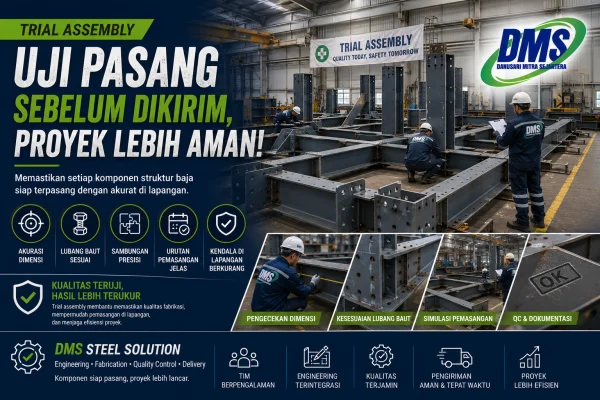
Trial assembly is the process of assembling some or all of the steel structural components in the workshop area before being sent to the project location. This stage is carried out as a simulation of the erection process to ensure that each part can be connected properly according to the shop drawing.
In this process, the fabrication team will arrange the components based on the planned installation sequence. All connections are checked to ensure that dimensions, bolt hole positions, connection details, and compatibility between components meet technical specifications.
Even though it is temporary, the trial assembly provides a real picture of how the structure will be installed in the field. If discrepancies are found, repairs can be carried out in a workshop that has complete facilities so that the correction process becomes faster and more efficient.
Ensures Dimensional and Joint Accuracy
One of the main goals of trial assembly is to verify the accuracy of the fabrication results. Each component must have a size that matches the shop drawing so that it can be assembled without obstacles.
Inspections are carried out on the length, width, position of bolt holes, connection angles, and alignment between structural elements. The slightest discrepancy can cause difficulties during erection, especially on projects with a very large number of components.
Through trial assembly, each connection can be tested directly so that potential production errors can be identified before the components are sent. This helps maintain the quality of fabrication results while reducing the risk of additional work at the project site.
Reduces the risk of problems during erection
The erection process is one of the most critical stages in the construction of steel structures. At this stage, all components must be assembled according to the planned sequence using heavy equipment and labor in the field.
If there are dimensional errors or mismatched connections, the erection process can stop and cause project delays. In some cases, components even have to be returned to the workshop for repair, which of course will increase time and costs.
Trial assembly helps reduce this risk by verifying before delivery. By ensuring that all components are appropriate, the installation process in the field can run more smoothly, safely and efficiently.
Helps Field Team Understand Installation Sequence
Apart from ensuring component compatibility, trial assembly also provides benefits for the erection team. During the test installation process, the assembly sequence can be studied so that the field team has a clearer picture of the installation method that will be carried out.
Components that have gone through trial assembly are usually equipped with the system marking or marking according to shop drawing. This label makes it easier to identify each part when it arrives at the project site so that the installation process is faster.
Understanding the installation sequence also helps optimize the use of lifting equipment, reduces material search time, and improves coordination between teams during work.
The Role of Quality Control in Trial Assembly
Trial assembly cannot be separated from the process Quality Control (QC). The QC team is tasked with ensuring that the fabrication results meet all technical requirements before the components are declared ready to be shipped.
Inspections include dimensional suitability, bolt hole positions, connection quality, marking accuracy, and compatibility with shop drawings. All inspection results are documented as part of the quality control system.
With this verification process, every component that leaves the workshop has gone through a thorough inspection. This approach helps increase customer confidence while ensuring that structures installed in the field conform to the approved design.
Trial Assembly Increases Project Efficiency
The biggest advantage of trial assembly is the increase in overall project efficiency. Problems discovered in the workshop are generally easier and cheaper to fix than when the components are already at the project site.
Repairs carried out early can reduce the risk of rework, speed up the erection process, and keep the project implementation schedule on track. Apart from that, coordination between divisions such as engineering, production, QC, logistics and field teams is better because all parties understand the actual condition of each component.
This efficiency ultimately has a positive impact on project costs, work productivity, and the overall quality of construction results.
PT. Danusari Mitra Sejahtera remains committed to delivering the best service to our clients. With over 19 years of experience in steel construction and fabrication, we support national infrastructure projects.
"Quality is our top priority in every project we deliver."
For more information about our products and services, please contact our team.