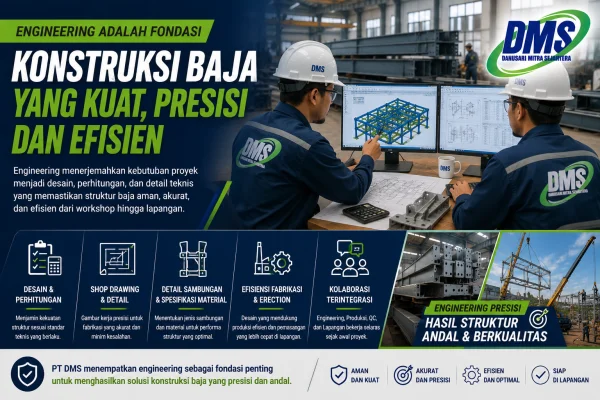
Engineering: The Main Foundation in Creating Strong, Precise and Efficient Steel Structures
In every steel construction project, success is not only determined by the quality of the material or the sophistication of the fabrication process. One of the most influential factors actually starts long before the production process is carried out, namely at the engineering stage. This is where all project requirements are translated into a technical design that can be accurately manufactured and safely installed in the field.
Engineering is a process that connects planning concepts with construction implementation. The engineering team is responsible for ensuring that each steel component is designed to meet the requirements for structural strength, efficient use of materials, ease of fabrication, and a smooth erection process. With careful planning, various potential obstacles can be anticipated from the start so that the project can run more effectively, safely and economically.
Engineering Turns Concepts Into Manufacturable Solutions
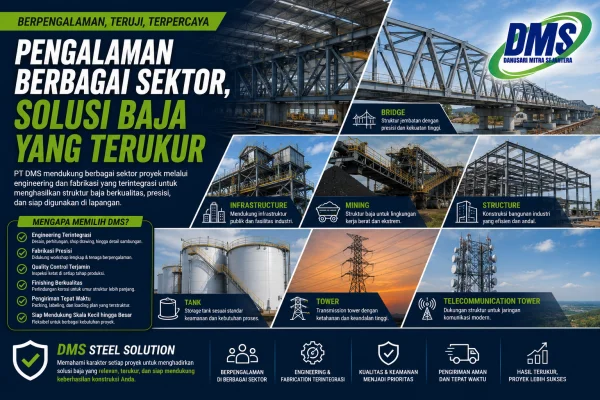
Every construction project has different needs. There are long-span bridge projects, industrial structures that must support heavy machinery, and telecommunications towers that must withstand wind loads. All these needs must be translated into a design that can be realized in reality through the engineering process.
The engineering stage begins by studying project needs, location data, building function, load capacity, and various applicable technical requirements. Based on this information, the engineering team developed a structural concept that was able to meet safety, strength and efficiency aspects.
At this stage, the engineer not only considers whether the structure can stand safely, but also how it can be produced efficiently in the workshop and easily installed in the field. This approach makes engineering a bridge between design theory and construction practice.
Structural Calculations Guarantee Strength and Safety
One of the main tasks of the engineering team is to carry out structural analysis and calculations. This calculation aims to ensure that all steel elements are able to withstand various types of loads that will work during the operational period.
These loads include dead loads from the structure itself, live loads due to usage activities, wind loads, earthquakes, machine vibrations, and environmental loads according to project characteristics. All parameters are analyzed using technical calculation methods and modern engineering software so that the results are accurate.
Through this process, engineers can determine the dimensions of the steel profile, connection type, bolt capacity, and appropriate bracing requirements. Thus, the structure is not only theoretically strong, but also has a level of safety that meets applicable engineering standards.
Shop Drawing Becomes a Precise Production Guide
After the design has been analyzed, the next stage is preparation shop drawings. This document is a detailed working drawing that is used as a reference during the fabrication process in the workshop.
Shop drawings contain information regarding the size of each component, bolt hole positions, welding details, material codes, assembly methods, and marking systems. Accuracy in preparing shop drawings really determines the quality of production results.
Small errors in working drawings can cause dimensional discrepancies, incorrect connection positions, or obstacles during erection in the field. Therefore, the process of reviewing and verifying shop drawings becomes an important part of the quality control system before production begins.
With accurate shop drawings, the fabrication process can run more efficiently, reduce the risk of rework, and ensure that all components can be assembled according to plan.
Exact Connection Details and Material Specifications
The success of a steel structure is not only determined by its main shape, but also by the quality of the connection details. The engineering team is tasked with determining the most suitable type of connection, whether using bolts, welding, or a combination of both.
Each connection detail is designed based on the load capacity that must be supported, the installation method, and the ease of the fabrication process. The position of the bolt holes, the size of the connection plate, the length of the welds, and the assembly sequence are all part of the engineering planning that must be calculated carefully.
Apart from that, selecting material specifications is also the responsibility of the engineering team. The type of steel used must suit the project needs, both in terms of strength, environmental resistance and cost efficiency. Choosing the right material helps produce a safe structure without excessive use of material.
Engineering Determines Fabrication and Erection Efficiency
Decisions taken at the engineering stage will greatly influence the fabrication process in the workshop. A design that is simple but still meets structural requirements will speed up the production process, reduce the number of joints, and increase productivity.
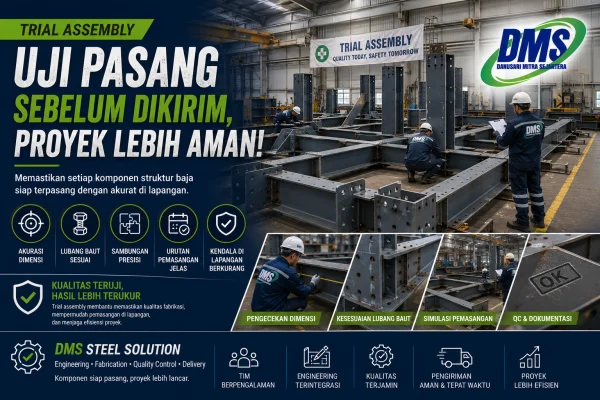
Apart from fabrication, engineering also determines the erection strategy at the project site. Components must be designed to be easy to transport, easy to lift using a crane, and can be installed in the planned sequence.
Considerations regarding component size, maximum weight, lifting methods, and vehicle access to the project location have all been considered since the engineering stage. This approach helps speed up the installation process while improving work safety in the field.
In other words, engineering not only produces drawings, but also develops strategies so that the entire construction process runs efficiently from start to finish.
Engineering Collaboration with Production, QC, and Field Teams
A successful steel construction project always involves good coordination between various divisions. The engineering team does not work separately, but collaborates closely with the production, quality control (QC), logistics and erection teams in the field.
Input from the production team helps engineers create designs that are easier to fabricate. Meanwhile, the QC team ensures that the production results comply with the shop drawings and technical specifications that have been determined.
Coordination with the field team is also very important to ensure the planned installation method can be implemented according to project conditions. If there are problems during implementation, the engineering team can provide technical solutions that still meet safety and quality standards.
Collaboration that occurs from the start will reduce the potential for communication errors, speed up project completion, and increase efficiency at every stage of work.
PT. Danusari Mitra Sejahtera remains committed to delivering the best service to our clients. With over 19 years of experience in steel construction and fabrication, we support national infrastructure projects.
"Quality is our top priority in every project we deliver."
For more information about our products and services, please contact our team.