Erection & Installation: Stages that determine the success of steel structures in the field
In steel construction projects, the success of a structure is not only determined by the quality of the design and fabrication process in the workshop. No matter how good the materials used and no matter how thorough the production process, the final quality of a structure still depends greatly on the installation process in the field. This is where service comes into play Erection & Installation becomes very important.
Erection is the process of installing and assembling steel components that have been produced into a complete structure according to the planned design. This stage is a bridge between the fabrication process and project operations. Mistakes at the erection stage can impact quality, safety, and even the success of the entire project. Therefore, this work requires careful planning, competent workforce, adequate equipment, and close supervision.
Why is Erection a Crucial Stage?
In the steel construction industry, erection is often referred to as the final realization stage of the entire engineering and fabrication process. All components that were previously produced separately must be assembled into a single structural unit that functions according to its intended purpose.
This process is not only related to the physical installation of components, but also ensures that all structural elements are in the right position according to working drawings and technical specifications. Accuracy of position, elevation, alignment and connections are factors that really determine the long-term performance of the structure.
Small errors in installation can cause dimensional discrepancies, difficulties when connecting subsequent components, and a potential reduction in the overall quality and safety of the structure. Therefore, erection is one of the most critical stages in the steel construction project cycle.
Preparation Stages Before Erection
Before erection work begins, a series of comprehensive preparations are required. This stage includes examining engineering documents, shop drawings, work methods, and work safety plans.
The project team must ensure that all components sent from the workshop comply with the approved materials list and working drawings. Apart from that, the condition of the project site must also be checked to ensure the readiness of the work area, access to heavy equipment, as well as the condition of the foundation or supporting structure that will receive the construction load.
Good planning at an early stage will help minimize obstacles during the installation process and increase the efficiency of carrying out work in the field.
Lifting and Component Placement Process
One of the main activities in erection is the lifting process or lifting steel components using a crane and other supporting equipment. This stage requires careful calculations because each component has a different weight, size and lifting point.
Errors in the lifting process can cause safety risks and material damage. Therefore, every lift must be carried out according to the lifting plan that has been prepared previously.
After the component has been successfully lifted, the next stage is placement in the specified position. This process requires good coordination between heavy equipment operators, riggers, field supervisors and the erection team to ensure installation runs safely and accurately.
The Importance of Alignment in Steel Construction
After the components are placed, the next job is to align or align the position of the structure. Alignment aims to ensure that each structural element is in the right position according to the engineering drawing.
Alignment checks are carried out using various measuring tools such as total stations, spirit levels, laser levels, and other survey equipment. Accuracy at this stage is very important because it will affect the installation of subsequent components.
Misaligned structures can cause difficulties when installing connections, reduce the aesthetics of the building, and even affect the load distribution on the structure. Therefore, alignment is one of the main indicators of the success of the erection process.
Final Connection and Completion of Structure
The next stage is the final connection or final connection between structural components. Connections can be high quality bolts or welding, depending on the specified design.
At this stage, each connection is checked in detail to ensure bolt tightness, welding quality, and compliance with the project's technical specifications. This inspection is very important because joints are points that play a role in transferring loads between structural elements.
After all connections are completed and declared to meet the requirements, the structure will undergo a final inspection before being declared ready for use or proceeding to the next stage of work.
The Role of Safety in Erection Work
Erection is one of the construction jobs with a fairly high level of risk. Heavy lifting activities, work at heights, and the use of heavy equipment require strict safety controls.
Therefore, every erection work must refer to established safety procedures. The use of personal protective equipment (PPE), work permits, equipment inspections, and daily safety briefings are an inseparable part of work implementation.
A strong safety culture not only protects the workforce, but also helps keep projects running smoothly and minimizes potential losses due to work accidents.
Experienced Team Support and Adequate Equipment
The success of the erection process really depends on the competency of the human resources involved. The erection team must have a good technical understanding of working drawings, installation methods and work safety procedures.
Apart from competent workforce, the use of proper equipment is also an important factor. Cranes, lifting gear, measuring tools and installation equipment must be in good condition and in accordance with work requirements.
The combination of experienced workforce, adequate equipment and effective coordination will result in a faster, safer and higher quality installation process.
Integrated Solutions from Workshop to Field
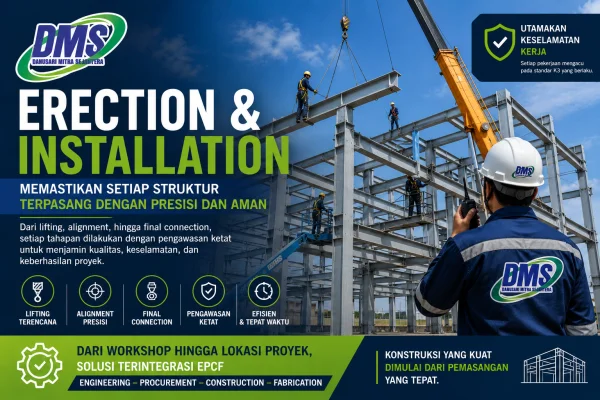
At PT Danusari Mitra Sejahtera (DMS), Erection & Installation services are part of an integrated solution that includes Engineering, Procurement, Construction & Fabrication (EPCF). This approach allows better coordination between the planning, production and field installation stages.
Every component produced in the workshop is installed with reference to the same quality standards until the structure stands intact at the project site. With an integrated work system, the potential for errors can be minimized and the quality of the final results can be maintained consistently.
For DMS, project success does not stop when the components are finished in production. Real success is when the entire structure is standing strong, safe, and ready to support customer operations in the long term.
Conclusion
Erection & Installation is a stage that really determines the success of a steel construction project. Through the process of lifting, alignment, final connection, and strict supervision, each component can be assembled into a structure that is safe, precise, and meets specifications.
Supported by an experienced workforce, adequate equipment, and an integrated coordination system, PT Danusari Mitra Sejahtera ensures that every project can be completed with high quality, on time, and in accordance with applicable safety standards.
Because in the end, quality steel structures are not only born from a good workshop, but also from the installation process which is carried out with precision and professionalism in the field.
PT. Danusari Mitra Sejahtera remains committed to delivering the best service to our clients. With over 19 years of experience in steel construction and fabrication, we support national infrastructure projects.
"Quality is our top priority in every project we deliver."
For more information about our products and services, please contact our team.